Why the World's Most Expensive Cities Are Making People Rethink Rent vs. Buy
From Sydney to San Francisco, rising prices and higher financing costs are reshaping the long-standing assumption that owning a home is always the smartest way to build wealth.

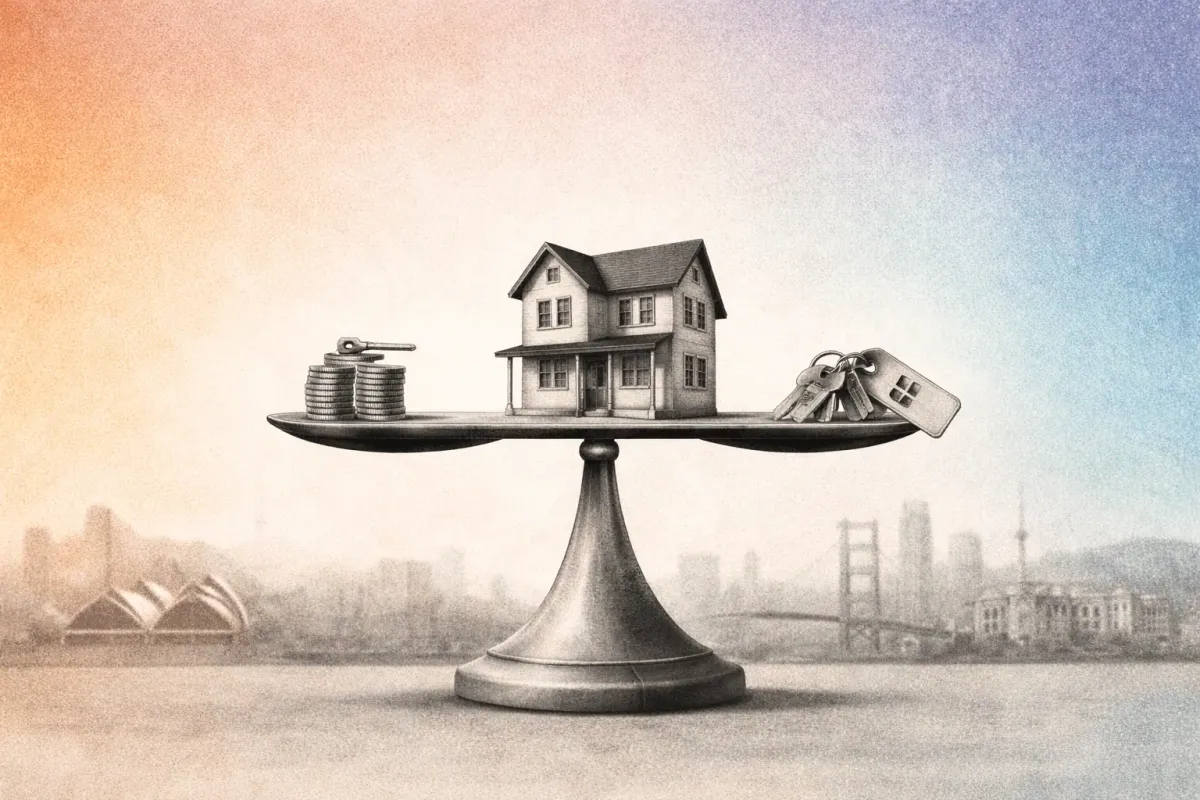
In 2025, not a single one of the 95 major housing markets tracked in the Demographia survey was considered affordable. It's the first time in the report's 20-year history.
Buying a home used to be how most people built wealth. You got a mortgage, paid it down over 30 years, and ended up owning something worth considerably more than what you paid.
In Sydney, Seoul, Amsterdam, San Francisco, and São Paulo, that math stopped working. Prices went up far enough that many people have given up on buying entirely. Some can't get to a down payment. Some could, and have decided the money makes more sense somewhere else.
🇦🇺 Sydney: 14:1 Price-to-Income Ratio
Take Sydney, where the median house price was roughly AUD $1.58 million while the median household income was around AUD $133,000. That's a price-to-income ratio of nearly 14:1, which puts Sydney second on the 2025 Demographia International Housing Affordability survey. The traditional affordability benchmark is 3.
There is no neighbourhood in Greater Sydney where someone earning the median full-time income can afford to buy. Researchers at UTS and UNSW found that Sydney will remain unaffordable until at least the 2030s. A household needs to earn around AUD $280,000 per year to comfortably service a mortgage on the median property, while the median household income is less than half that.
🇰🇷 Seoul: Move to Monthly Contracts
South Korea's housing finance system doesn't look like anywhere else's. Jeonse is an arrangement where a tenant pays a large lump-sum deposit, typically 50 to 80 percent of the property's value, and lives rent-free for the duration of the lease. The landlord invests that deposit and earns returns on it. At the end of the term, the full deposit is returned.
With interest rates rising and investment returns falling, landlords have been shifting toward monthly contracts, where the economics make more sense for them. Monthly rentals hit a record 64.6% of all new Seoul housing leases in early 2025, the highest since data collection began in 2011. The jeonse-to-homeownership pathway that many Korean families used across generations is increasingly unavailable to younger households.
The Korea Herald reports that the average Seoul apartment now costs over ₩1.1 billion, roughly USD $800,000, against a price-to-income ratio of around 13.9. Only 25.8% of Seoul households in their 30s own homes, the lowest figure since the government began tracking it. With supply projected to fall 48% in 2026 and demand holding steady, ownership isn't getting more accessible anytime soon.
🇳🇱 Amsterdam: Housing Policy
Amsterdam is worth looking at separately, because the government has actually tried to fix it.
The average property price in Amsterdam now sits at around €640,000, against a price-to-income ratio of roughly 10 to 12 times the median household income, significantly above the Dutch national average of 7 to 8. The government's response has included a higher transfer tax for investment buyers, new capital gains treatment on rental properties, and the "opkoopbescherming" or buy-up protection rule, which prevents buyers from renting out a newly purchased property for the first four years. The intent is to push more homes toward owner-occupation and out of the investor-landlord market.
The effect has been mixed. Investor sell-offs have added inventory in some segments, but supply remains well below what the city needs: Amsterdam aims to build around 7,500 homes per year, yet actual deliveries consistently fall short. For many Amsterdam residents, the decision is increasingly not theirs to make.
🇺🇸 San Francisco: When Both Renting & Owning are Expensive
If you want a city where the numbers make the most unambiguous case for renting over buying, San Francisco is likely it. The median home price sits around $1.3 million. The city's median household income is $145,000. According to CBRE data, a new mortgage in San Francisco averaged around $10,420 per month as of mid-2025. The median rent for an apartment in the city is about $3,285.
Around 37.6% of San Francisco residents own their homes, which is one of the lowest ownership rates among major U.S. cities and reflects a market where a very large share of residents, including many with above-average incomes, have calculated that renting makes more sense. A household needs roughly $340,000 to $400,000 in annual income to comfortably service a median-priced home purchase with 20% down. Only about 11% of renter households in the city meet that threshold.
What's notable about San Francisco is that rents are also genuinely high, around 55% above the national median. This isn't a case where renting is cheap and buying is expensive. Both are expensive. However, the $270,000 down payment on a median property is a significant sum that, if invested, compounds at a very different rate than residential real estate in a market that has been volatile and, in some segments, has actually declined over the past few years.
🇧🇷 São Paulo: High Interest Rates
Central São Paulo apartments cost significantly less in absolute terms than those in Sydney or San Francisco. But the benchmark interest rate for the Brazilian economy hit 14.75% in 2025, pushing home loan rates into the 12% to 14% range. With those financing rates, the total cost of a property over the life of a mortgage approaches double the purchase price. Buyers who can pay cash face reasonable prices. For everyone else, the financing costs are the problem.
Renting in São Paulo frees up capital that, in a high-rate environment, earns meaningful returns by simply sitting in savings accounts. Buying with a mortgage in a 13% interest rate environment means paying close to double the property's value over the life of the loan.
Forced Savings Mechanism
The strongest counterargument to all of this is the wealth-building function of homeownership. In the United States, the median homeowner's net worth is around $400,000, compared to roughly $10,000 for the median renter. That gap is real, and it reflects decades of compulsory savings and leverage.
How much of that gap comes from rising home values, and how much is just the effect of making mortgage payments for decades? Research suggests appreciation accounts for a significant share, especially in high-growth periods; however, making regular principal payments builds equity even when prices don't move. If long-term home price growth slows or flattens, the bulk of wealth gained may increasingly come from disciplined saving rather than market windfalls.
The answer depends on where you live and how long you plan to stay. In markets with more reasonable price-to-income ratios, buying remains a solid long-term financial decision. The cities above aren't representative of every market. But in the cities that attract young workers and set the terms of how housing gets talked about, a growing share of residents are concluding that the case for buying no longer holds.