The $895 Credit Card and the $6 Value Meal: Who Your Price Tag Was Designed For

What happened to dollar deals at McDonald's? Why are premium cards like American Express getting pricier while the economy feels unstable? The answer lies in what economists now call the E-Shaped economy. Let me explain.
In 2020, economists started calling the economy K-shaped. After the pandemic, one segment—homeowners who refinanced at 3%, remote knowledge workers—saw wealth grow. They moved up and right. Another segment, mainly hourly workers and renters, fell behind. Hence, the K.
Earlier this year, Bank of America used internal spending data to divide customers into three income brackets and track their paths. Top-tier spending kept rising. Bottom-tier spending kept falling. The middle tier, earning $50,000-$125,000, moved sideways.
Economists have started referring to this as the new E-shaped economy, after the three horizontal bars of the letter. What's interesting outside economist circles is how closely new and revised products and services map to these three tiers.
Three different versions of 2026
The top 10% of American earners now account for nearly half of all consumer spending in the country, according to Moody's Analytics. The spending growth gap between higher-income households and everyone else reached its widest point since mid-2022 in January of this year.
Heather Long, one of the economists who helped popularize the K-shape framework, now describes the middle class as "spending in a nervous way." These are households that can still cover their bills, take vacations, and contribute to their retirement accounts. But their spending confidence is thin. More of their purchases go to wholesale retailers like Costco to stretch dollars.
The bottom tier is taking on more debt. Among cardholders earning $25,000-$50,000, 59% have carried a credit card balance in the past year. Buy Now, Pay Later services have become more common at this income level, financing purchases like groceries. The Richmond Fed noted this year that 65% of BNPL loans in recent origination periods went to subprime or deep-subprime borrowers.
What companies have figured out
The most telling thing about the E-shaped economy is how quickly companies shaped products to match these three groups.
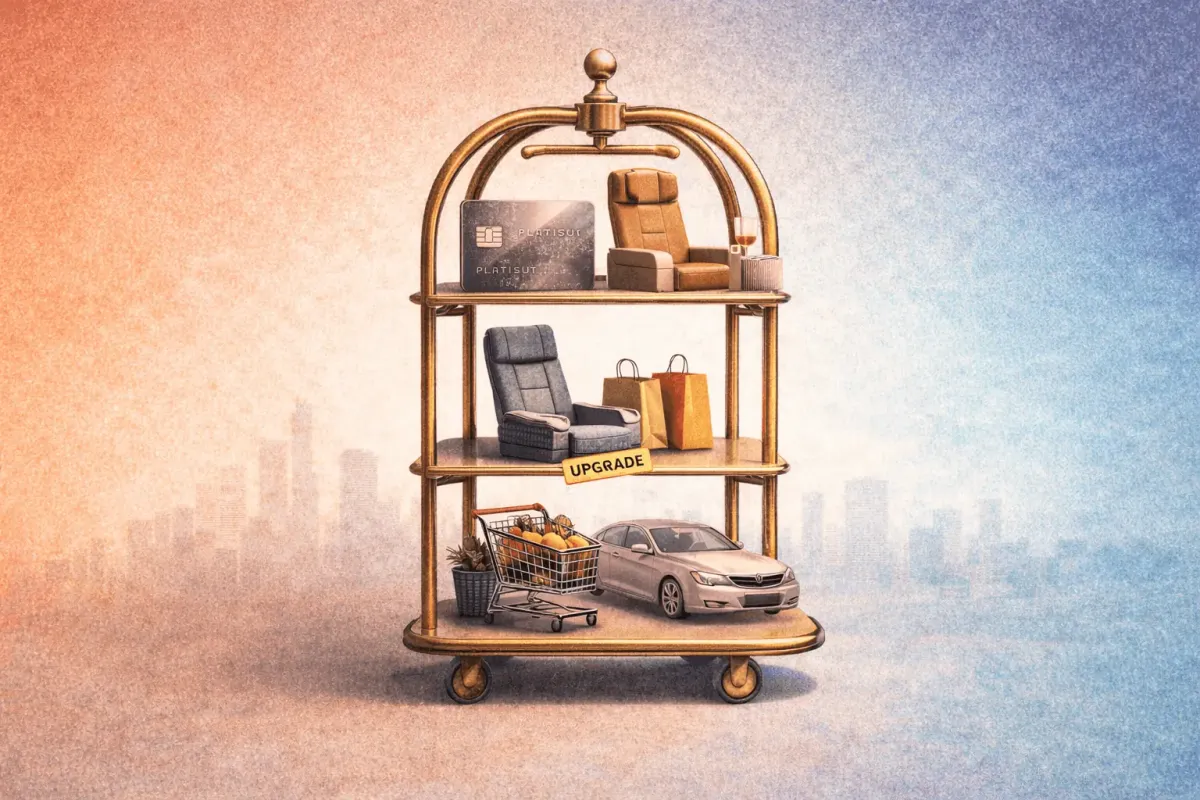
American Express raised the Platinum annual fee to $895 this year. Chase pushed the Sapphire Reserve to $795. Both added partnerships that reinforce a particular lifestyle above all else: Resy dining credits, Lululemon perks, Oura ring subscriptions, and expanded lounge access. The no-annual-fee card market, by contrast, has gone flat. There's little appetite to design around at the lower tiers.
Airlines show the same pattern. Delta, United, American, and JetBlue have all begun cabin refits that add premium economy seats, often by removing first class. First class previously served a small, wealthy group at high margins; main cabin served everyone else at much smaller margins. Premium economy sits between them, and the airlines have figured out that the middle tier will still trade up for a single flight.
The grocery aisle has undergone a similar split. Aldi, a discount grocery chain, opened 264 stores this year and is on pace for 800 U.S. locations by 2028. Sprouts, a higher-end brand, added 52. Whole Foods continues to focus on upmarket specialty. All three are growing. Conventional supermarkets like Kroger and Safeway are losing share because they continue to try to cater to all three consumer segments rather than focus on one.
Fast food has priced out its core customer. Twelve major chains retired true dollar-menu items this year, replacing them with bundled "value" tiers — $4, $6, $8. For decades, fast food was the cheapest meal option. That role is over. Households that relied on the dollar menu eat out less or have stopped eating out. The industry is now chasing the middle tier's willingness to spend over $8 for a burger, as seen with McDonald's Big Arch and Burger King's new Whopper.
Streaming companies are also following suit. 46% of U.S. subscribers now use ad-supported plans, which drive 71% of net subscriber growth across major platforms. The premium, ad-free tier still exists, but it has become a top-tier product almost by default. Whether you experience a show with or without commercial breaks is now largely a function of household income, despite the content library being identical.
The nihilistic splurge and the Costco run
Among younger consumers, the E-shape creates spending that jumps between tiers. Analysts call it the nihilistic splurge: redirecting money toward immediate wants in uncertain times: a $400 dinner, an expensive concert ticket, a jacket you've eyed for months. It's a deliberate choice to spend on something memorable, because saving toward a future that feels increasingly theoretical feels pointless.
This coexists, often within the same person, with the Costco run. The same 30-year-old checking unit prices on canned tomatoes might spend $250 on a tasting menu the following weekend. The E-shaped economy, at the individual level, isn't always about which tier you occupy. Many people hold two financial postures at once, switching between them depending on immediate needs and when the paycheck is deposited.
Seeing the price tag for what it is
Once you look through this lens, you'll see it everywhere. The $895 credit card is priced for its tier, with perks to reinforce that identity. The $6 Wendy's combo is the new floor, set by higher input costs, and marketed as "value."
Understanding the E-shaped economy doesn't tell you how to spend, but it shows the strategy behind each price—whether you're buying for your life, or because it's meant to make you feel like you belong elsewhere.