How Household Spending Has Changed Over the Last Decade: From 2016 to 2026
What 28 to 45 year olds are buying more (and less) of compared to a decade ago.

Maria Melchor, a financial content creator put it plainly in a widely viewed TikTok:
"When older people ask me how young people are affording nice things that they wouldn't even buy for themselves, I tell them it's because we can't afford anything else."

If you feel poorer than your parents, you're not alone. The median house now costs five times the average income, up from four times in 2016. Homeownership among under-35s has dropped to 37%, a far cry from the 60% rate boomers enjoyed at the same age. Rent-to-income ratios hit a historic high of 29.2% at the end of 2022, with over half of American households spending more than 30% of their income on rent. In New York, that ratio sits at 58%.
Housing may be the root of the story, but it's not everything.
The substitution that isn't quite a substitution
Here's what's interesting: the same demographic being squeezed out of housing has been fueling a rise in spending on experiences. 79% of 18 to 35 year olds plan to attend more events in 2026. And the wellness industry alone now runs $500 billion a year, growing 5% annually. The average gym membership costs $101.80 a month. Half of gym-goees say fitness is central to who they are.
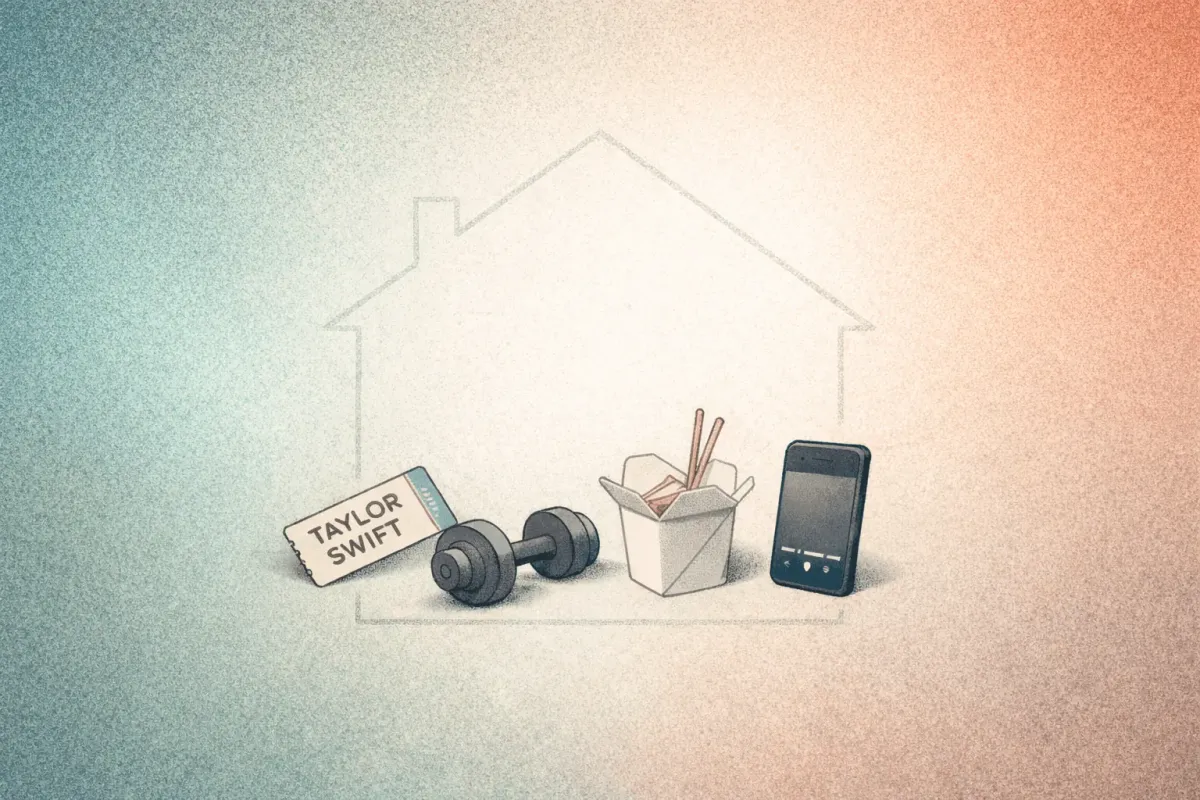
The easy explanation is substitution. Can't buy a house? Buy a Taylor Swift ticket instead. There's truth in that. Melchor again: "Homeownership or starting a family is so out of reach that we're using that down payment money on whatever it is we can afford that'll bring us a semblance of the kind of adulthood we were promised."
But substitution doesn't fully explain why millennials and Gen Z, who make up just over a third of adults, account for 41% of all wellness spending. Or why pet industry spending nearly doubled from $67 billion in 2016 to $152 billion in 2024. These aren't splurges, with money being frittered away on impulse purchases. They're fixed monthly expenses, with money being allocated, deliberately, toward a different kind of life than the one previous generations built.
The technology layer
Some of this is simply about what's now possible to buy, that didn't exist a decade ago.
Between 2016 and 2022, more than 25.5 million households cut the cable cord. Initially, the average cord cutter saved about $1,000 a year. That didn't last. By 2024, the typical household was paying $52 a month for four streaming services. Netflix premium jumped from $7.99 in 2016 to $24.99 today.
Food delivery followed the same pattern. DoorDash started with 70 Bay Area restaurants in 2016. It now handles $80 billion in orders a year. The average American spends $1,566 annually on delivery, about 3.7% of median income. In five years, delivery's share of food spending more than doubled, from 9% to 21%.
These aren't the same category as concert tickets or gym memberships. The streaming subscriptions and delivery apps have become new fixed costs in a household's budget. When people talk about feeling like they have less money, this is part of what they mean. The baseline cost of participating in normal life has shifted.
The contradiction in the data
Despite everything above, younger generations are saving more than ever. Millennials started saving at 24, eight years earlier than boomers. They're the most likely generation to budget. Net worth for Americans under 40 has soared 80% since 2019.
But most of that wealth is tied up in investments and retirement accounts. It's not cash being spent on groceries or used for a down payment. And even if you could access it, housing prices have outpaced the growth.
So you have a generation that is simultaneously more financially disciplined than their parents, wealthier on paper, and less able to afford the things their parents bought at the same age. They budget with care, but spend freely on experiences. They start saving early, but juggle subscription debt. They're optimistic enough to invest, and pessimistic enough that nearly half admit to 'doom spending' just to cope with the anxiety.
What the shopping cart reveals
The spending shifts of the past decade aren't random. Housing became more out of reach. Streaming and food delivery are now considered fixed household costs. Wellness and pets became identity categories. Experiences absorbed, in part, what would have been down payment savings.
For a generation priced out of the traditional markers of adulthood, this new makeup of household spending makes a lot of sense.
So what comes next? The oldest millennials turn 45 this year. They're aging into what should be peak earning and spending years. Will homeownership finally tick upward, or will the next decade see consistent growth of existing spending patterns, with even more money funneled into experiences, wellness, and convenience?